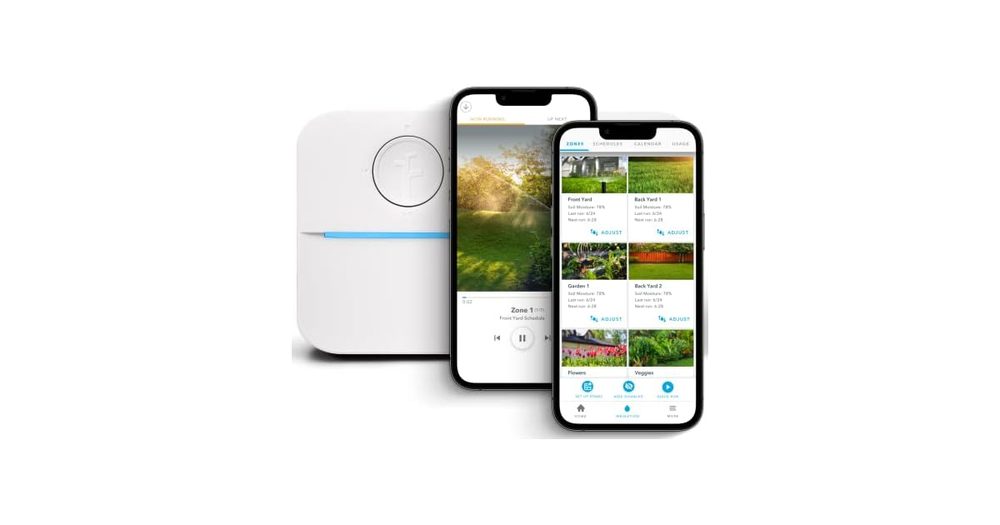
From simple wind-up dials to app-controlled multi-zone timers, these are the hose-faucet timers that water on schedule while you are busy with everything else.
Last updated: September 2026
We may earn a commission if you buy through our Amazon links. It does not change what you pay or how the tools are ranked.
How we sized them up
This is a spec-led shortlist built from published specs and retailer listings. We compared outlet count, schedule flexibility, maximum run time, rain-delay options, power source, pressure ratings and price. This guide covers hose-faucet timers only — in-ground smart irrigation controllers are a separate category with their own wiring and valve boxes.
The quick cut
Start with how many hoses you need to control, then check the scheduling range and whether you want batteries or Bluetooth. Tap any pick to jump straight to the full breakdown.
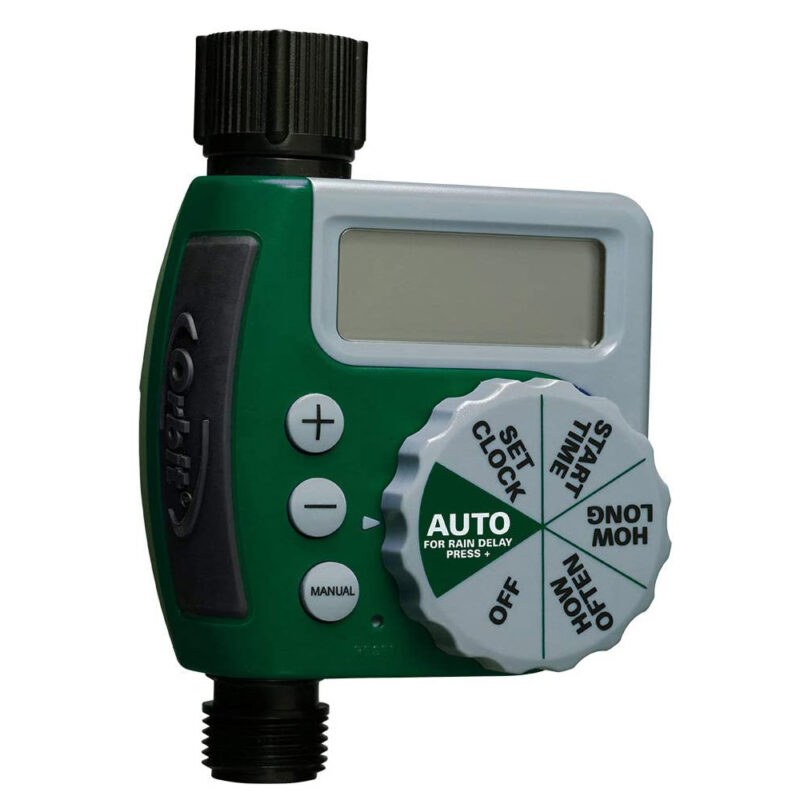
Orbit Single-Outlet Digital Hose Faucet Timer (62061Z)
ASIN B004INGS8S
Product image: Prime Tech retail listing.
Who it’s forThis is the safe default for one faucet and one hose. The big dial walks through set-clock, start-time, duration and frequency, so programming takes minutes. Watering runs go from 1 to 240 minutes and repeat every 6 hours up to every 7 days, with a 24/48/72-hour rain delay and a manual override for hand watering. Around $30 puts it squarely mid-pack, and tens of thousands of 4.3-star reviews have made it the category’s long-standing best seller.
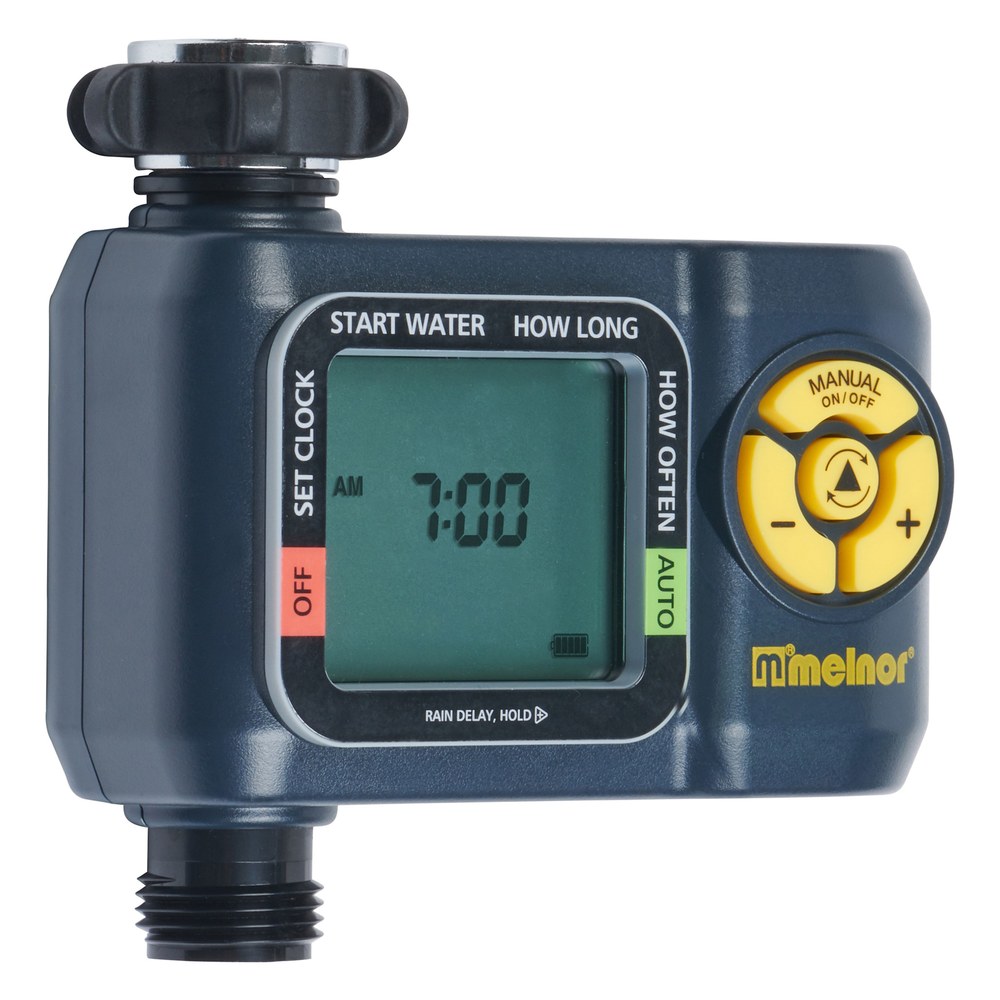
Melnor AquaTimer 1-Zone Digital Water Timer (65138AMZ)
ASIN B0B9DHW65X
Product image: Wagon Wheel retail listing.
Who it’s forProgrammed with three buttons — start water, how long, how often — the AquaTimer’s interface is about as plain as a digital timer gets. The oversized LCD stays readable in bright sun, and the manual on/off button covers quick jobs without touching the schedule. Rain delay is built in for wet weeks. This is the pick for someone who wants a set-and-forget timer on a single hose without learning a dial system.
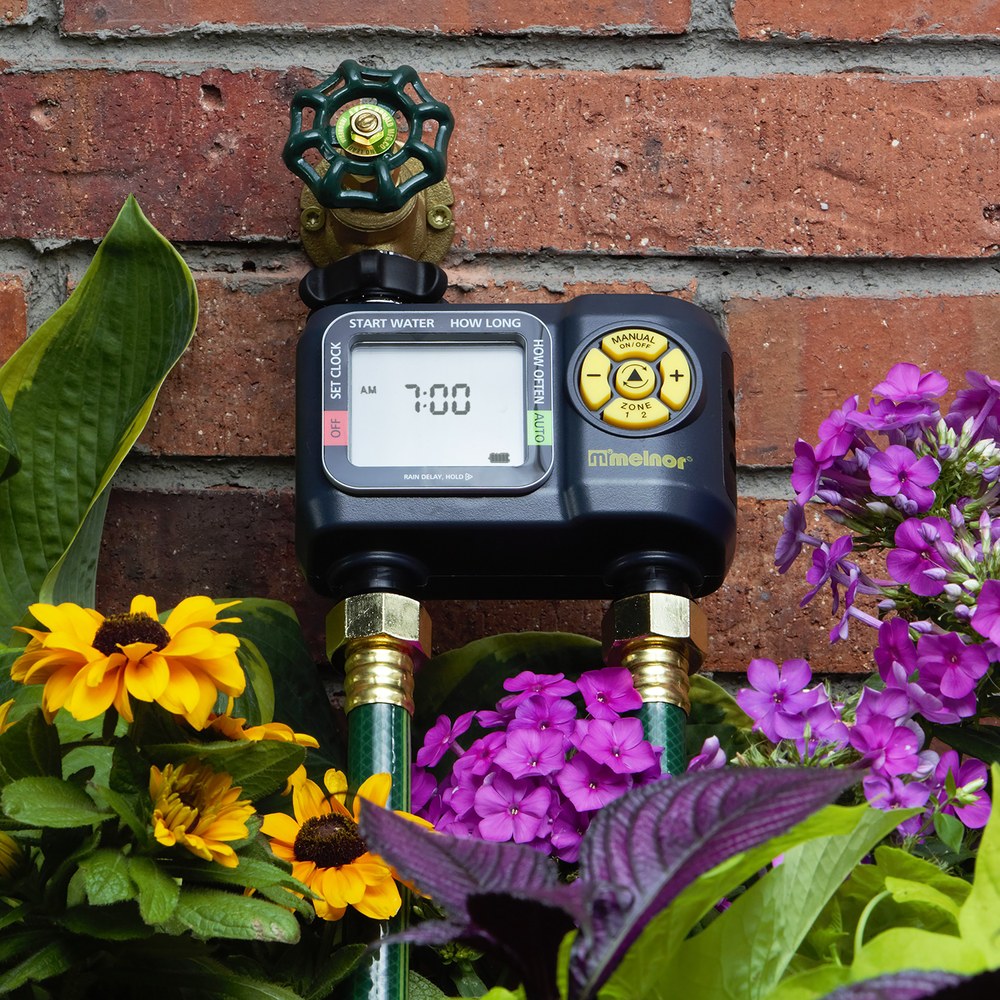
Melnor AquaTimer 2-Zone Digital Water Timer (65139AMZ)
ASIN B0D54HLN6Y
Product image: Eaton Brothers retail listing.
Who it’s forOne faucet, two independent schedules. Each of the two valves programs separately, with watering from 1 minute to 6 hours and frequency from hourly through weekly — enough range to keep the lawn on one hose and the drip line on the other. Rain delay stretches to 7 days, and the whole unit runs on 2 AAs. At around $36, it costs only a little more than Melnor’s single-zone model while doubling what the faucet can do.
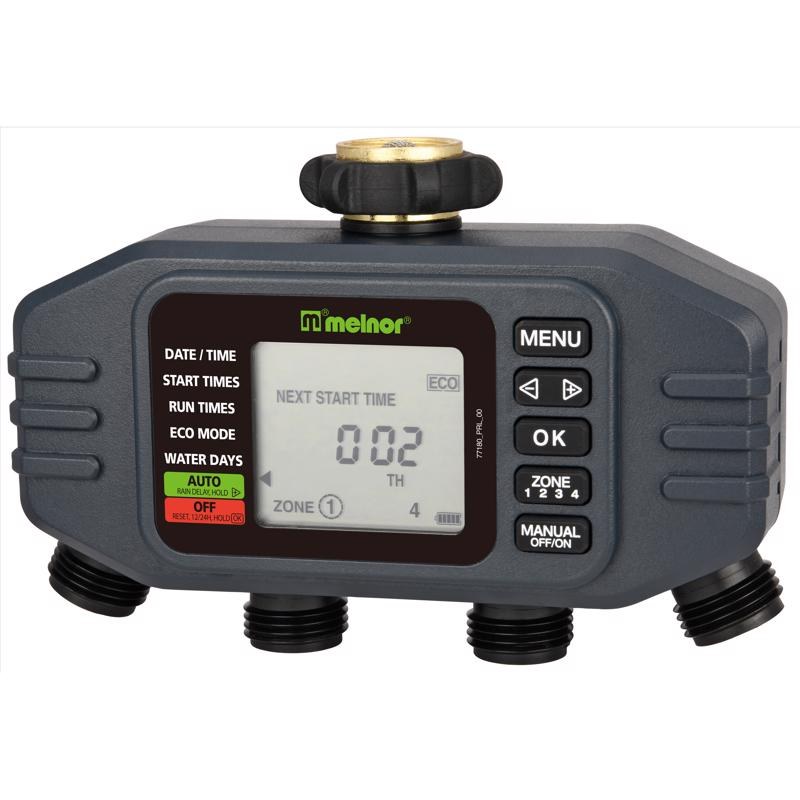
Melnor AquaTimer 4-Zone Digital Water Timer (65140AMZ)
ASIN B09YZ2782J
Product image: Max Warehouse retail listing.
Who it’s forFour independent valves off one spigot — lawn, beds, containers and drip all get their own schedule without a buried irrigation system. Each zone waters 1 minute to 6 hours on an hourly-to-weekly frequency, with rain delay up to 7 days. Amazon buyers rate it around 4.1 stars from roughly 1,900 reviews. Zones water one after another, which is gentler on household water pressure than running everything at once. It costs a step up from the two-zone model, but it is still far cheaper than trenching for an in-ground system.
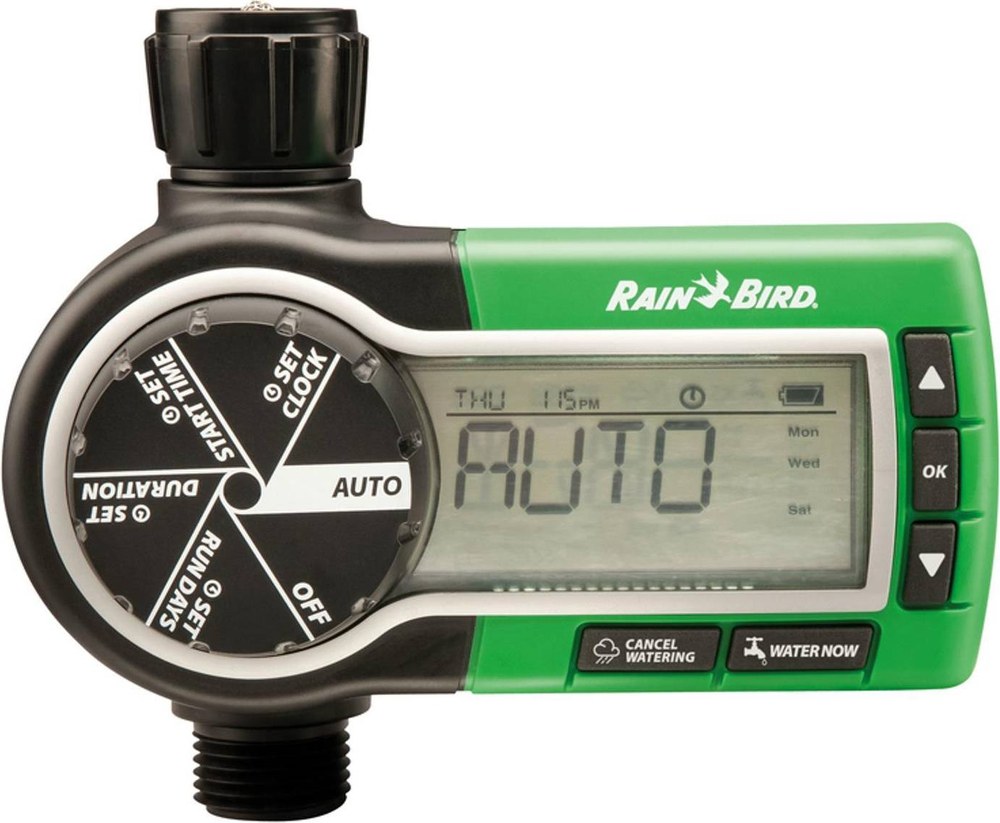
Who it’s forRain Bird’s professional irrigation heritage shows in the specs: an operating range of 15 to 90 psi and flow of 5 to 12 GPM, which covers both low-pressure drip setups and full-pressure sprinklers. Scheduling runs up to 6 hours per cycle with two start times per day, plus a 96-hour rain delay, custom weekday selection and separate water-now and cancel buttons. Around $47 and a 4.4-star average from over 3,800 reviews make it the pricier-but-proven single-outlet option.
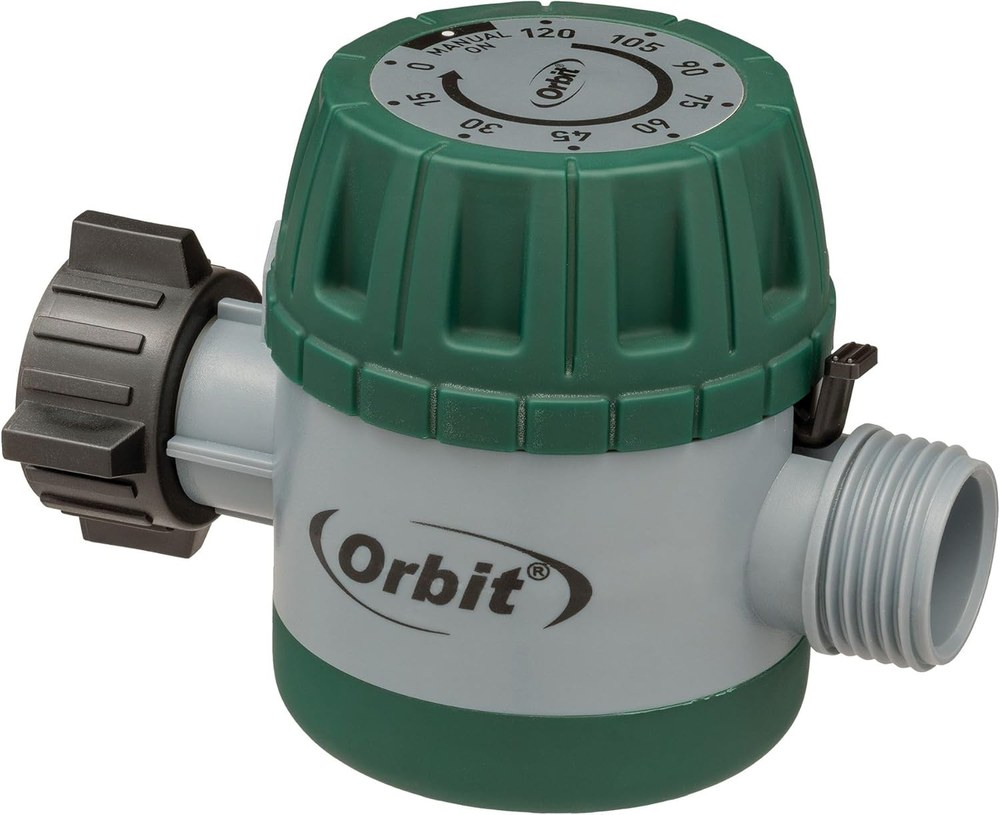
Who it’s forTwist the dial to the number of minutes, walk away — the spring mechanism shuts the water off anywhere from 15 to 120 minutes later, with a manual-on setting for open-ended watering. No batteries, no screen, no schedule to program, and about $12 at checkout. The 4.3-star average across more than 15,000 reviews reflects a simple truth: a timer you never have to think about gets used more than a clever one.
Gilmour Single-Outlet Electronic Water Timer (830134-1001)
ASIN B00CWRKYFK
Product image: Hardware Store retail listing.
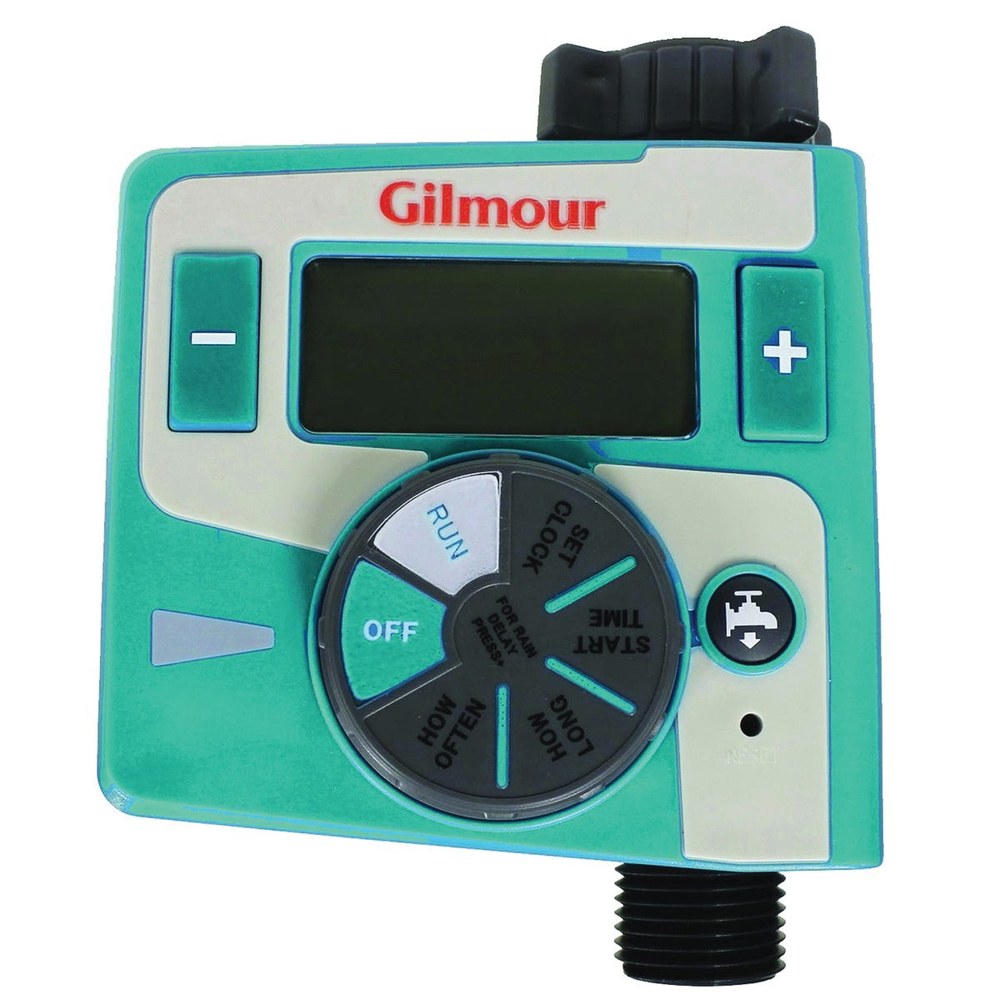
Who it’s forMost single-outlet timers top out around 4 hours; this Gilmour runs up to 360 minutes — a full 6 hours — per cycle, which suits slow-soak drip lines and newly seeded lawns. The large LCD makes programming readable, and a rain-delay setting of 24, 48 or 72 hours pauses everything for wet weather. A thoughtful touch: the valve closes automatically if the batteries run low, so the valve closes automatically when the batteries run low. Around $28 with a metal swivel coupling.
Gilmour Single-Outlet Mechanical Water Timer (820054-1001)
ASIN B00IJG4FEE
Product image: Zoro product listing.
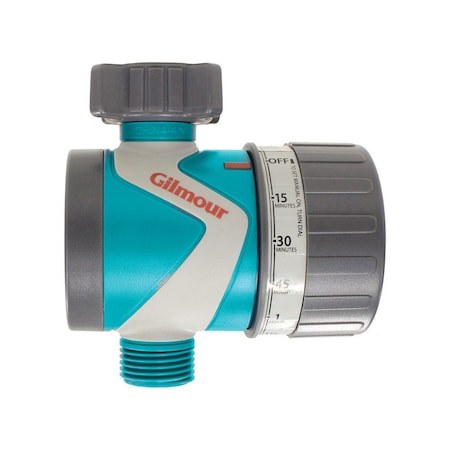
Who it’s forA mechanical timer with a metal swivel coupling — the part that threads onto the faucet and takes the most abuse. Dial up 1 to 120 minutes of watering, or use the manual setting for open flow. Like all mechanical timers, it is a countdown device with no recurring schedule, but it needs no batteries and costs around $14. Buy this one when the timer lives permanently on an exposed faucet and you want the connection hardware to outlast the season.
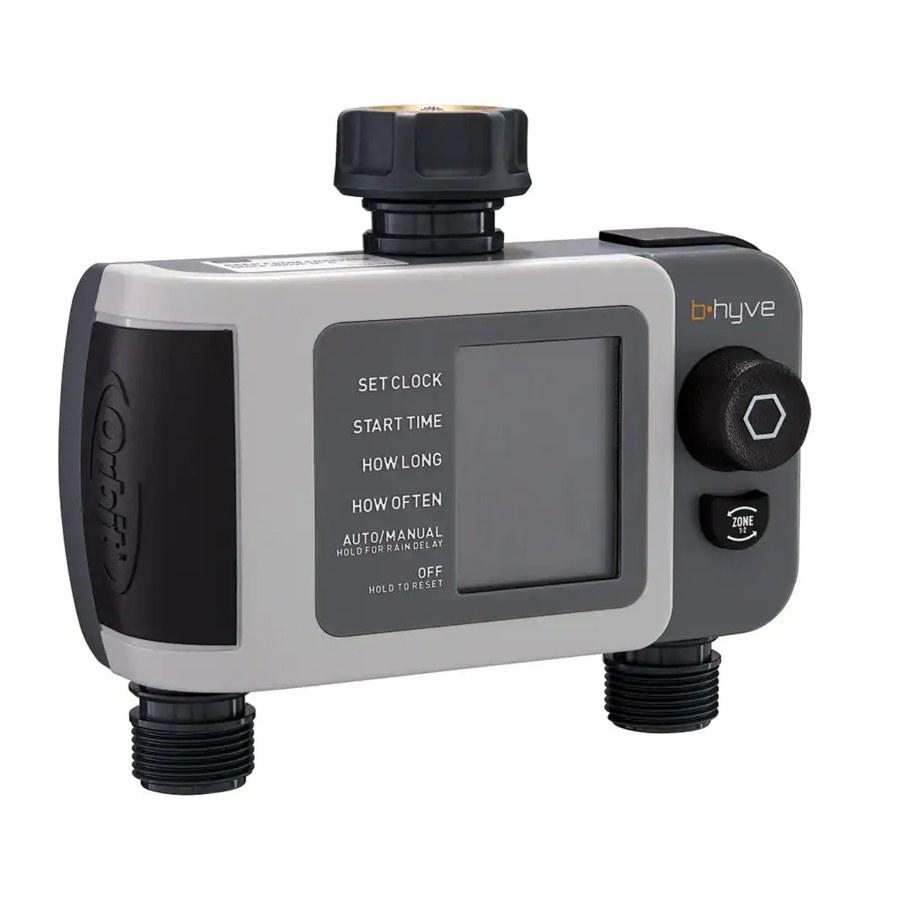
Who it’s forTwo independently programmed outlets with app control and weather-based scheduling — the B-hyve app adjusts watering to local rain and temperature so the schedule skips itself. Bluetooth programming works straight out of the box, and adding the Wi-Fi hub (sold separately) unlocks remote control from anywhere. Around $70 is a real step up from basic timers, but it replaces two timers and a second spigot for anyone watering two areas on different plans.
Specifications
Outlets
2 independent
Control
Bluetooth app; Wi-Fi with hub (sold separately)
Scheduling
Weather-based smart watering
Coupling
Brass hose faucet swivel
Power
2 AA batteries
Pros
App control with weather-based schedules
Two independent outlets
Works over Bluetooth without the hub
Cons
Remote access needs the Wi-Fi hub, sold separately
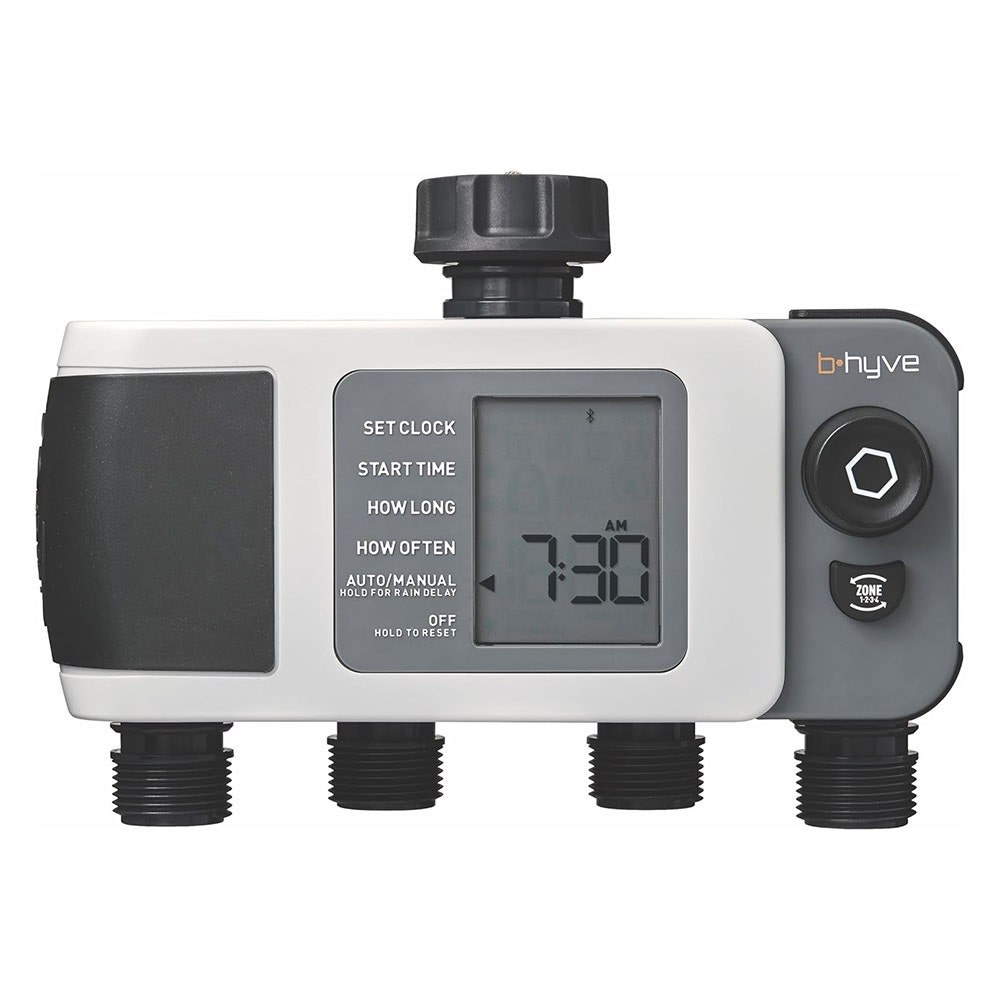
Who it’s forEverything the two-port offers — app programming, weather-based schedules, Bluetooth with optional Wi-Fi hub — doubled to four independently controlled outlets. It is the closest a hose bib gets to a real multi-zone irrigation controller, without any valves to bury or wires to run. Reviewers give it around 4.0 stars from over 1,200 ratings. Expect the highest price in this guide and the heaviest unit hanging off the faucet; a Y-splitter won’t help here because each outlet keeps its own schedule.
Specifications
Outlets
4 independent
Control
Bluetooth app; Wi-Fi with hub (sold separately)
Scheduling
Weather-based smart watering
Coupling
Brass hose faucet swivel
Power
2 AA batteries
Pros
Four app-controlled zones, no buried valves
Weather-based scheduling
Bluetooth works without the hub
Cons
Remote access needs the Wi-Fi hub, sold separately
Match the timer to your faucet count and how much scheduling you actually want to manage.
Mechanical vs. digital
A mechanical timer is a spring-driven countdown dial: set minutes, walk away, and the water stops. No batteries, no programming, and prices start near $12. A digital timer repeats schedules automatically — daily, every few days, or weekly — but needs AA batteries and a few minutes of setup. Pick mechanical for occasional watering and digital for anything that should run while you are away.
Outlets and zones
Single-outlet timers serve one hose. Multi-outlet models put two or four independently programmed valves on one faucet, so the lawn, beds and drip line each keep their own schedule. More outlets mean a bulkier unit hanging off the spigot, and zones on one timer water in sequence, one after another.
Schedule flexibility
Check the run-time ceiling: many timers top out at 120 minutes per cycle, while others reach 4 or 6 hours for deep soaking. Frequency matters too — some repeat every few hours, others only on chosen days of the week. New seed and drip lines reward long, infrequent runs; established lawns do fine on shorter, regular cycles.
Rain delay
A rain-delay button pauses the schedule for 24 hours to 7 days without erasing your programming. Smart timers go further by adjusting to local weather automatically. Either way, the feature exists to keep the timer from watering through a downpour — use it.
Batteries
Nearly every digital hose timer runs on two AA batteries, typically lasting a season or two. Change them at the start of the watering season and keep a spare set in the garden tote. One note: most timers lose their programming when batteries die, so fresh batteries matter as much as the schedule itself.
Pressure limits
Most timers handle standard household pressure of 30 to 100 psi, but the fine print varies. Drip systems running at very low pressure need a timer rated down to around 10–15 psi, or the valve may never open. If you are on a well with pressure swings, published pressure ranges are worth reading before checkout.
What to avoid
Skip timers with no rain-delay option if storms are part of your summer. Avoid plastic-only couplings on timers that will live permanently on an outdoor faucet — metal swivels survive hose tugging and seasonal removal. Bring any timer inside before hard freezes; ice splits valve bodies regardless of brand. And size the timer to the job: a four-zone app timer on a single potted-plant hose is money spent on features you will never open.
Specifications are based on published manufacturer and retailer information for the listed models. Check the current product listing for package contents and compatibility before ordering.